

If you’ve been diagnosed with a bulging disc after an accident, you need a realistic figure, not a vague “it depends”. This guide sets out what the Judicial College Guidelines say and what moves your claim up or down within them.
For a quicker answer, try our back injury claim calculator for an instant estimate based on the type and severity of your injury.
How much are bulging disc compensation payouts in the UK?
Bulging disc compensation payouts in the UK range from £3,240 for a minor injury with a full recovery to £212,670 for the most severe cases involving spinal cord and nerve root damage. Where your claim falls within that range depends on how severe your injury is, whether a nerve is affected and how long your recovery takes.
The table below is based on the 18th edition Judicial College Guidelines (April 2026), the reference used by solicitors and courts across England and Wales to value disc injuries.
| Injury Severity | Compensation range |
| Severe (i) | £120,340 to £212,670 |
| Severe (ii) | £97,980 to £116,820 |
| Severe (iii) | £51,230 to £92,130 |
| Moderate | £36,680 to £51,230 |
| Minor (2 to 5 years) | £16,520 to £36,680 |
| Minor (under 2 years) | £3,240 to £16,520 |
Source: Judicial College Guidelines, 18th Edition (April 2026)
These figures cover general damages only, which is compensation for your pain, suffering and loss of amenity. Your financial losses are calculated separately as special damages and added on top of general damages for your bulging disc compensation payout.
Is a bulging disc the same as a herniated disc?
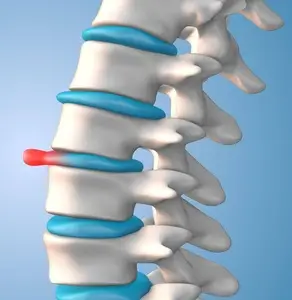
Often, yes. In everyday use and in many medical settings, “bulging disc”, “herniated disc”, “slipped disc” and “prolapsed disc” describe the same problem, where a spinal disc presses outwards and can irritate a nearby nerve. The NHS slipped disc page describes a slipped, prolapsed or herniated disc as the same condition.
Some clinicians draw a distinction. They treat a bulge as milder, where the disc’s outer wall stays intact, and a herniation as more serious, where the wall tears and the inner gel pushes through.
For your claim, the label matters far less than what the injury does to you. A valuation follows your symptoms, whether a nerve is affected and your prognosis. A bulging disc causing lasting nerve pain can be worth considerably more than a herniation that settles within months.
For more on how these injuries are valued, see our herniated disc guide.
What makes a bulging disc claim worth more?
Your bulging injury sits in one of the brackets above and a handful of factors decide whether it lands at the lower or upper end of the spectrum.
- Nerve involvement. A bulge pressing on a nerve is often the single biggest factor, as sciatica or arm symptoms usually point to a worse prognosis and can move a claim towards “Severe”. See the NHS sciatica page.
- Surgery. If surgery has been carried out or is recommended, your valuation typically rises, even if you decide against the operation.
- Recovery time. The longer your symptoms last, the more your claim is typically worth. A recovery within two years is usually valued lowest and permanent symptoms are typically valued highest of all.
- Age and occupation. These mainly affect your financial losses, since a younger claimant may face more years of lost earnings and an injury that ends a manual career can cost far more than one that allows a return to desk work.
- Medical evidence. An independent expert’s report that shows a clear link between your symptoms and the accident may support a higher valuation
How much compensation for a bulging disc in the neck?
Compensation for a bulging disc in the neck typically ranges from £3,240 for a minor injury to £172,970 for the most severe cases. Where your claim falls usually depends on how long your symptoms last and whether a nerve is affected.
| Injury Severity | Compensation range |
| Minor | £3,240 to £10,420 |
| Moderate | £33,020 to £50,850 |
| Severe | £86,870 to £172,970 |
Source: Judicial College Guidelines, 18th Edition (April 2026)
A bulging disc in the neck, known as a cervical disc injury, often produces different symptoms to one in the lower back. These may include:
- Neck pain and stiffness, sometimes with headaches
- Pain, numbness or tingling that travels into the shoulder, arm or hand
- Weakness in the arm or a weaker grip
Arm symptoms usually indicate that a nerve is being pressed, which may place a claim in a higher bracket.
Bulging disc car accident compensation: what’s different?
Bulging disc car accident compensation is typically assessed in the same way as any other bulging disc claim but how the injury happens raises a few extra issues.
Force of impact and delayed symptoms
A collision can place sudden force on the spine and even a lower-speed impact may be enough to injure a disc. Symptoms may not appear straight away and can develop over days or weeks, so it is worth seeing a doctor promptly. An MRI scan is often needed to confirm the injury.
Fault and liability
Your compensation depends on showing that another driver was fully or partly to blame. Any share of fault attributed to you may reduce your award. You can estimate your injury’s value with our car accident claim calculator and our car accident solicitors can advise on liability.
The whiplash tariff and disc injuries
The government’s fixed whiplash tariff typically does not apply to a bulging disc. It covers soft tissue injuries lasting up to two years, such as sprains, tears of muscles, tendons and ligaments. A disc is not a muscle, tendon or ligament, so a bulging disc is usually valued separately under the Judicial College Guidelines.
If your bulging disc followed a car accident, call us on 01507 609027 for a free assessment of your claim.
Can you claim for a bulging disc at work?
You may be able to make a back injury at work claim for a bulging disc if your employer’s negligence caused or contributed to your injury.
Employer duties on manual handling
Under the Manual Handling Operations Regulations 1992, employers must avoid hazardous manual handling where reasonably practicable. Where they cannot, they must assess the risk and reduce it. A failure to do so may form the basis of a claim.
Common causes of workplace disc injuries
- Lifting and carrying: heavy or awkward loads handled without training or equipment.
- Repetitive movement: frequent bending, twisting or awkward postures over time.
- Falls: from height or on the same level. If your fall happened in a public place rather than at work, see our slips, trips and falls page.
What else can you claim for?
Along with compensation for the injury itself, you may be able to claim for the financial losses your bulging disc has caused. These are known as special damages.
Financial losses you may be able to claim
- Lost earnings: income lost while you are off work, and future earnings if your injury affects your ability to work.
- Treatment costs: including private physiotherapy, medication, scans or surgery.
- Care and assistance: help from family members or professional carers during your recovery.
- Travel expenses: journeys to medical appointments and treatment.
How long do you have to make a claim?
You generally have three years to make a bulging disc claim, running from the date of the accident or your date of knowledge.
Date of knowledge
A bulging disc does not always cause symptoms straight away as some develop gradually through repeated strain. In those cases, the three years may run from your date of knowledge. This is the point at which you first realised your injury was significant and linked to someone else’s negligence, as set out in Section 14 of the Limitation Act 1980.
Exceptions
- Under 18 at the time: the three years does not start until your 18th birthday, giving you until you turn 21 to claim.
- Lacking mental capacity: no time limit applies until capacity is regained.
Speak to a back injury solicitor today
A bulging disc can leave you in constant pain and struggling to work, with no certainty that your claim will cover what you have lost. At Nigel Askew Solicitors, we help you pursue the maximum bulging disc compensation you may be entitled to.
- One senior personal injury solicitor stays with your case from your first call through to settlement.
- We have over 30 years of experience helping injured claimants recover maximum compensation.
- We instruct independent medical experts and barristers where your case needs them, so your injury and prognosis are properly evidenced.
- Most claims are handled on a No Win No Fee basis and we can visit you at home if travel is difficult.
Call us today on 01507 609027 to talk through your bulging disc claim, with a free, no-obligation consultation.