
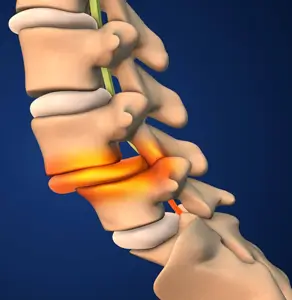

Herniated disc at work compensation ranges from £3,240 for a minor injury to £212,670 for the most severe cases involving nerve root damage. These figures cover general damages only and come from the 18th edition Judicial College Guidelines.
Where your slipped disc compensation falls within that range depends on the severity of your herniation, whether a nerve is affected, and how long your recovery takes. Use our back injury claim calculator for an instant estimate based on your specific injury.
What is a herniated disc and is it different from a slipped disc?
A herniated disc happens when one of the soft, rubbery cushions between the bones in your spine gets damaged. This can happen suddenly or develop gradually through repeated strain over months or years.
A herniated disc, slipped disc and prolapsed disc are all names for the same injury. There is no clinical difference between them. For more information on the condition, see the NHS guide to slipped discs.
Herniated discs are generally categorised by how far the disc material has moved:
- Protrusion: the inner gel presses against the outer wall of the disc but the wall itself remains intact
- Extrusion: the inner gel breaks through the outer wall but is still connected to the parent disc
- Sequestration: a fragment of disc material breaks away completely and is no longer connected
The more advanced the herniation, the more likely it is to press on surrounding nerves. This in turn has a direct bearing on both your symptoms and your compensation.
How much for herniated disc at work compensation?
Herniated disc compensation ranges from £3,240 for a minor injury with a full recovery, to £212,670 for the most severe cases involving spinal cord and nerve root damage.
The compensation figures below are based on the 18th edition Judicial College Guidelines (published April 2026). This is the same reference used by solicitors and courts across England and Wales to value herniated, prolapsed and slipped disc injuries.
| Severity | Compensation Range | What this covers |
| Severe (i) | £120,340 – £212,670 | Spinal cord and nerve root damage, incomplete paralysis |
| Severe (ii) | £97,980 – £116,820 | Significant permanent damage, impaired mobility |
| Severe (iii) | £51,230 – £92,130 | Fractured discs or vertebrae, chronic pain |
| Moderate | £36,680 – £51,230 | Disc lesions with a substantial risk of osteoarthritis |
| Minor (recovery 2–5 years) | £16,520 – £36,680 | Disc prolapse with lasting symptoms |
| Minor (recovery under 2 years) | £3,240 – £16,520 | Full or near-full recovery expected |
These figures above cover general damages only, which relates to compensation for your pain, suffering and loss of amenity.
For the full range of back injury brackets beyond disc-specific claims, see our back injury at work compensation guide.
How is compensation calculated for a slipped disc?
Compensation for a slipped disc claim is made up of two elements: general damages and special damages. Both form part of the same claim, and knowing what each one covers helps you understand where your final figure actually comes from.
General damages
General damages reflect the personal impact your slipped disc has had on you. This covers:
- The physical pain of the herniation itself, from the initial injury through to your ongoing recovery
- Any psychological impact, such as anxiety or low mood linked to chronic pain or reduced mobility
- Loss of amenity or everyday activities you can no longer manage because of the injury
Special damages
Special damages cover the financial losses your slipped disc has caused. This typically include:
- Past and future loss of earnings if your injury has stopped you working or affected the type of work you can do
- Physiotherapy, spinal injections or surgery costs
- Prescription and other treatment expenses
- Travel to and from medical appointments
- Care and assistance provided by family members during your recovery
- Home adaptations where mobility has been permanently affected
Why nerve involvement changes your compensation bracket
Whether your herniated disc is pressing on a nerve is often the single biggest factor separating a moderate claim from a severe one.
When a disc herniates in the lower spine, it can press against the sciatic nerve, causing sciatica: pain that radiates from the lower back through the buttock and down the leg, sometimes with numbness, tingling or weakness. You can read more about the condition on the NHS sciatica page.
Nerve involvement can change the medical picture significantly:
- Without nerve involvement: a disc injury often resolves with rest and physiotherapy within months.
- With nerve involvement: the prognosis is typically worse, with a higher likelihood of permanent symptoms and often a need for ongoing pain management or surgery.
These are the factors an independent medical expert evaluates when assessing the severity of your slipped disc injury. Nerve involvement is what typically pushes a claim from the Moderate bracket into Severe (iii) or Severe (ii), rather than the presence of the herniation alone.
Two people can suffer what looks like the same slipped disc. Yet they can settle for very different amounts. One recovers fully. The other is left with lasting nerve damage.
What causes a herniated disc at work?
The most common cause of a herniated disc at work is improper heavy lifting, especially when combined with twisting or bending the spine.
The main causes we see include:
- Improper lifting to carry heavy loads
- Twisting while lifting or carrying objects
- Prolonged sitting at the desk
- Repetitive strain from repeating bending
Poor workstation ergonomics, whole-body vibration from operating machinery, and natural wear and tear from age or excess body weight can also increase the risk of a herniated disc from work.
Employers have specific legal obligations to prevent these risks. Under the Manual Handling Operations Regulations 1992, your employer must:
- Avoid hazardous manual handling tasks wherever reasonably practicable
- Assess the risk of any manual handling that cannot be avoided
- Reduce that risk as far as reasonably practicable, including through training and lifting equipment
A failure to meet any of these three duties is one of the strongest grounds for a slipped disc compensation claim.
Average payout for herniated disc – Illustrative examples
The average payout for a herniated disc varies significantly depending on the severity of the injury and the financial losses involved. The three examples below illustrate that range, showing how general damages and special damages combine in practice.
Example 1: Warehouse operative with a herniated disc and sciatica
General damages: £51,230 – £92,130
Special damages: lost earnings to date £18,000, future loss of earning capacity £85,000, care and assistance £6,000, treatment and travel £3,500 (£112,500)
Potential claim value: approximately £163,730 – £204,630
Example 2: Office worker with a herniated disc from a fall
General damages: £16,520 – £36,680
Special damages: lost earnings to date £4,200, treatment and travel £1,800 (£6,000)
Potential claim value: approximately £22,520 – £42,680
Example 3: Delivery driver with a disc prolapse
General damages: £5,750 – £16,520
Special damages: lost earnings to date £2,100, treatment costs £900 (£3,000)
Potential claim value: approximately £8,750 – £19,520
These figures are illustrative only. The only way to know the true value of your claim is through a proper assessment with a back injury at work solicitor. Call us on 01507 609027.
How do I prove my herniated disc happened at work?
Proving your herniated disc happened at work depends on building a clear evidential link between the injury and the incident that caused it. You will generally need the following:
- Medical records: seek medical attention promptly, even if your symptoms initially seem minor
- Accident book entry: report the incident to your employer as soon as possible
- Witness details: names and contact details of anyone who saw what happened
- Risk assessment and training records: evidence of whether your employer properly assessed the manual handling task and trained you to carry it out safely
Disc injuries carry a particular evidential challenge. A herniation is not always visible on initial examination, and MRI or CT imaging is often needed to confirm the diagnosis and link it clearly to the accident.
With this being the case, prompt and thorough medical evidence is essential to support a genuine slipped disc at work claim.
How long do you have to claim for a slipped disc at work?
You generally have three years to make a herniated disc at work claim, running from the date of the accident or your date of knowledge.
For a herniated disc that developed gradually, the three year rule runs from your date of knowledge. This is the point at which you first realised your symptoms were significant and linked to your work. This is set out under Section 14 of the Limitation Act 1980.
Two exceptions extend this period. If you were under 18 at the time, the three years does not start until your 18th birthday, giving you until you turn 21 to claim. For those lacking mental capacity, no time limit applies until capacity is regained.
Can you still work with a herniated disc?
Many people with a herniated disc can continue working, often with temporary adjustments, though this depends entirely on your role and the severity of any nerve involvement.
Your GP can issue a fit note confirming what you can and cannot do during your recovery. If you need time off, you may be entitled to Statutory Sick Pay while you recover.
Your employer should also consider reasonable adjustments to help you stay in work or return sooner, including:
- Reduced hours while your symptoms settle
- Altered duties that avoid heavy lifting or prolonged bending
- Ergonomic changes to your workstation or equipment
- A phased return, gradually increasing your hours and responsibilities over time
If you can return to your previous role within a reasonable timeframe, your loss of earnings is limited to that recovery period. If you cannot, and your injury permanently affects your ability to do your job, future loss of earning capacity becomes a major component of your total herniated disc compensation claim.
Slipped disc compensation – FAQs
Can I work with a herniated disc?
Yes, many people can continue working with a herniated disc, often with temporary adjustments such as reduced hours or altered duties. Whether you can return to your previous role affects the value of your claim, since it determines how much you can claim for lost earnings and future earning capacity.
What's the difference between a herniated disc and a slipped disc?
There is no difference. Herniated disc, slipped disc and prolapsed disc are all names for the same injury, where the soft centre of a spinal disc pushes through a tear in its outer layer.
How long does a herniated disc claim take to settle?
A herniated disc claim typically takes 9 to 18 months where liability is accepted and your injuries have stabilised. Claims involving surgery or nerve damage can take 2 to 4 years, since settlement should never happen before your long-term prognosis is clear.
Can I claim if my slipped disc happened gradually rather than in one accident?
Yes, you can still claim for a herniated disc that developed gradually through repeated manual handling or poor working conditions. The three-year time limit runs from your date of knowledge, the point at which you first linked your symptoms to your work, rather than from any single incident.
Do I need surgery to make a claim?
No, surgery is not required to make a slipped disc claim. If surgery is recommended, this increases your compensation because it reflects the objective severity of your injury, even if you choose not to proceed with the operation.
Speak to our back injury solicitors today
Your slipped disc at work compensation claim deserves more than a call centre and a case number. When you call Nigel Askew Solicitors, you get direct access to the expertise and dedication needed to secure the maximum compensation you deserve.
- A senior solicitor handles your case personally from your first call to final settlement.
- Over 30 years experience recovering compensation for injured workers across England and Wales.
- We work with independent medical experts and barristers to build the strongest possible case and maximise your award.
- Most claims are handled on a No Win No Fee basis, with home visits available if your injuries make travel difficult.
Call Nigel Askew Solicitors today on 01507 609027 for your free, no-obligation consultation.