
Defective work equipment solicitors
If you have been injured by faulty or defective equipment at work, you may be entitled to make a No Win No Fee claim. Injuries caused by unsafe machinery, tools or equipment can be serious and, in some cases, life-changing.
Nigel Askew Solicitors handles defective work equipment claims across Lincolnshire and the surrounding areas. Call us today on 01507 609027 for free legal advice.
ACCIDENT AT WORK CALCULATOR
Injured in a work accident?
Find out how much your claim is worth in 15 seconds
- No Win No Fee claims
- Over 30 years’ experience
- Claim maximum compensation
Free, no-obligation check or call 01507 609027
Can I make a defective work equipment claim?
Yes. If you were injured by defective work equipment and your employer failed in their legal duty to provide and maintain safe equipment, you are entitled to make a defective work equipment claim.
Defective work equipment compensation claims can be made by:
- Full and part-time employees
- Agency and temporary workers
- Zero-hours contract workers
- Self-employed contractors and CIS subcontractors
- Workers injured while using equipment outside their normal workplace
To make a successful claim, the following three conditions must be met.
- The equipment must have been defective
- Your injury must have been caused by that defect
- And the accident must have occurred within the last three years.
What is the Employer's Liability (Defective Equipment) Act 1969?
The Employer’s Liability (Defective Equipment) Act 1969 makes employers strictly liable for injuries caused by defective equipment at work. Before this Act, injured workers had to prove their employer was directly at fault.
The Act removed that barrier entirely. Your employer cannot escape liability by blaming the manufacturer or a maintenance company. If the equipment was faulty and you were injured as a result, the responsibility rests with them.
Two further regulations strengthen your position:
- PUWER 1998: requires all workplace equipment to be suitable, properly maintained and used only by trained workers
- LOLER 1998: sets specific safety requirements for lifting equipment, including mandatory inspection intervals and load limits
What counts as defective work equipment?
Work equipment does not need to be visibly broken to be considered defective. Any equipment that does not function as it should or has not been properly maintained can form the basis of a defective work equipment claim.
Defective work equipment can include:
- Machinery: factory machines, presses, conveyor belts and production equipment with mechanical faults or missing safety guards
- Hand tools: drills, grinders, saws and other tools with worn, broken or defective components
- Vehicles and plant machinery: forklifts, cranes, lorries and site vehicles with mechanical or safety defects
- Ladders and scaffolding: damaged, unstable or incorrectly assembled access equipment
- Lifting equipment: hoists, chains, slings and lifting platforms that fail to meet LOLER safety standards
- Electrical equipment: tools or machinery with faulty wiring, inadequate insulation or defective components
- PPC equipment: helmets, gloves, harnesses, goggles and masks that are ill-fitting, damaged or fail to meet safety standards
What types of faulty work equipment injuries can you claim for?
Defective equipment injuries range from minor soft tissue damage through to life-changing and fatal injuries. Our accident at work solicitors handle defective work equipment compensation claims for a wide range of injuries, including:
- Crush injuries and amputations
- Fractures and broken bones
- Lacerations and cuts
- Burns and electrocution
- Spinal and back injuries
- Head and traumatic brain injuries
- Eye injuries and hand injuries
- Respiratory injuries
- Psychological trauma and PTSD
How much compensation can I claim for a defective work equipment injury?
The compensation you can claim for a defective work equipment injury depends on the severity of your injuries and the wider impact on your life. As a guide, the figures below are based on the latest 2026 Judicial College Guidelines, the framework used by courts and insurers across England and Wales.
| Injury Type | Severity | Estimated Payout Range |
| Head injury | Severe | £289,420 – £372,570 |
| Back Injury | Moderate | £16,520 – £51,220 |
| Hand Injury | Minor | Up to £7,480 |
| Leg Injury | Moderate | £24,780 – £51,800 |
| Foot Injury | Severe | £55,460 – £144,870 |
These figures cover general damages for pain and suffering. Your total claim may also include special damages covering lost earnings, medical treatment costs, rehabilitation, care costs and adaptations to your home or vehicle.
Every faulty work equipment claim is different. For a quick estimate, try our work accident calculator or call us on 01507 609027 for a free assessment of what your claim may be worth.
What should you do after a defective equipment accident at work?
The steps you take after a defective equipment accident can have a direct impact on the strength of your claim. Evidence can disappear quickly and acting promptly protects your position.
- Seek medical attention immediately even if your injury seems minor. Some injuries, including internal trauma, are not immediately apparent.
- Report the accident to your employer and ensure it is recorded in the accident book. Ask for a copy.
- Photograph the scene and equipment including your injuries, as soon as possible after the accident.
- Preserve all evidence and do not allow the defective equipment to be repaired or disposed of before your claim is assessed.
- Collect witness details including names and contact details of anyone who saw the accident.
- Do not give a statement to your employer’s insurer without speaking to a solicitor first. It can be used to reduce or deny your claim.
- Call Nigel Askew Solicitors on 01507 609027 for free legal advice and an honest assessment of your claim.
How long do you have to make a defective work equipment claim?
In most cases, you have three years from the date of your accident to start a defective work equipment claim.
However, there are exceptions to this rule:
- Standard rule: 3 years from the date of the accident or injury
- Industrial disease or delayed diagnosis: 3 years from the date you became aware of the injury or its cause
- Under-18s: the 3-year period begins on their 18th birthday
- Fatal accidents: 3 years from the date of death or the date of knowledge
- Claimants without mental capacity: the limitation period may be suspended indefinitely
Do not wait. Defective equipment gets repaired or replaced, witness memories fade and physical evidence disappears. The sooner you contact us, the stronger your claim is likely to be.
How to make a defective equipment at work claim?
Starting a claim after a serious injury can feel overwhelming. Once you instruct us, we manage every stage of your defective work equipment claim from start to finish.
The process involves:
- Free initial consultation: we review the details of your accident at no cost and give you an honest assessment of whether you have a claim worth pursuing.
- No Win No Fee agreement: If we take your case on, we explain the terms clearly before you sign anything. No upfront costs and no fees if your claim is unsuccessful.
- Evidence collation: we gather evidence, request accident records, and instruct independent medical experts to assess your injuries.
- Letter of claim: we formally notify your employer’s insurers of your intention to claim and set out the basis of your case.
- Liability response: the insurer has a set period to admit or deny responsibility. If liability is admitted, we move straight to valuing your claim.
- Medical assessment: a specialist examines your injuries, your recovery progress and your long-term prognosis. This report forms the foundation of your compensation valuation.
- Negotiation and settlement: we negotiate the maximum possible compensation on your behalf. The vast majority of defective work equipment claims settle without going to court.
Defective work equipment FAQs
No. Nigel Askew Solicitors handles all defective work equipment claims on a No Win No Fee basis. There are no upfront costs and nothing to pay if your claim is unsuccessful. If your claim succeeds, our ‘success fee’ is agreed as a percentage of your compensation before we begin, so there are no surprises.
Yes, you can still make a claim even if your employer says the accident was your fault. Employers routinely dispute liability after workplace accidents. What matters is the evidence. If the equipment was defective and your employer failed in their duty to maintain and inspect it, they may be liable regardless of what they tell you.
Yes. Under the Employer’s Liability (Defective Equipment) Act 1969, your employer cannot escape liability by blaming the manufacturer. If the equipment they provided was defective and caused your injury, the legal responsibility rests with your employer. They may pursue a separate claim against the manufacturer, but that does not affect your right to claim.
Yes, self-employed workers and contractors can make a defective work equipment claim. Employers and principal contractors owe a duty of care to everyone using their equipment, regardless of employment status. This includes CIS subcontractors, agency workers and zero-hours contract workers, all of whom are protected under the same legislation as permanent employees.
Being partly to blame for a defective work equipment accident does not stop you from claiming. Under contributory negligence rules, compensation is reduced to reflect your share of the blame. If you were found 25% responsible, you would still receive 75% of the total value. Partial fault is common in equipment claims and rarely prevents a successful outcome.
Yes, you can claim whether the equipment was hired, leased or owned outright. Your employer’s legal duty to provide safe equipment applies regardless of how that equipment was obtained.
It is unlikely you will have to go to court. Over 95% of defective work equipment claims settle through negotiation before reaching a hearing. Insurers rarely want the cost and uncertainty of court proceedings. In the rare cases that do proceed to court, we prepare you thoroughly and represent you at every stage.
How long your defective work equipment claim takes depends on its complexity. Straightforward claims where liability is undisputed typically resolve within 6 to 12 months. Claims involving serious injuries or disputed liability can take 12 to 24 months or longer. Starting your claim promptly avoids delays caused by missing evidence or equipment being repaired or disposed of before it can be examined.
How can Nigel Askew Solicitors support my claim?
At Nigel Askew Solicitors, your defective work equipment claim is handled personally by a senior personal injury solicitor with over 30 years’ of experience. One solicitor. First call to final settlement.
- Millions secured in compensation for injured workers across the country
- No Win No Fee with no upfront costs and nothing to pay if unsuccessful
- Direct access to leading medical experts and barristers throughout your claim
- Home visits available across Lincolnshire and the surrounding areas
Start your faulty work equipment claim
If you were injured by defective or faulty work equipment, contact our personal injury solicitors today. We regularly support clients throughout Lincolnshire, and the surrounding areas, including Nottingham, Sheffield and Derby.
Call Nigel Askew Solicitors today on 01507 609027 for your free, no-obligation consultation.
- 100% No Win No Fee Claims
- Free Initial Legal Advice
- Over 30 Year’s Experience
Call Us Today
Recent Cases

Claim for serious injuries as a result of an accident at work when the client’s hand was trapped in machinery.

Our client developed chronic pain in her shoulder and elbow whilst working in a food processing plant.
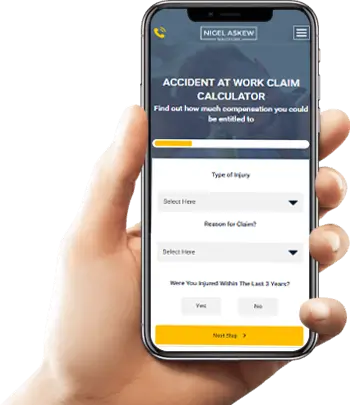
Injured at work? Try our free work accident compensation calculator.
Check your eligibility in just 30 seconds.